
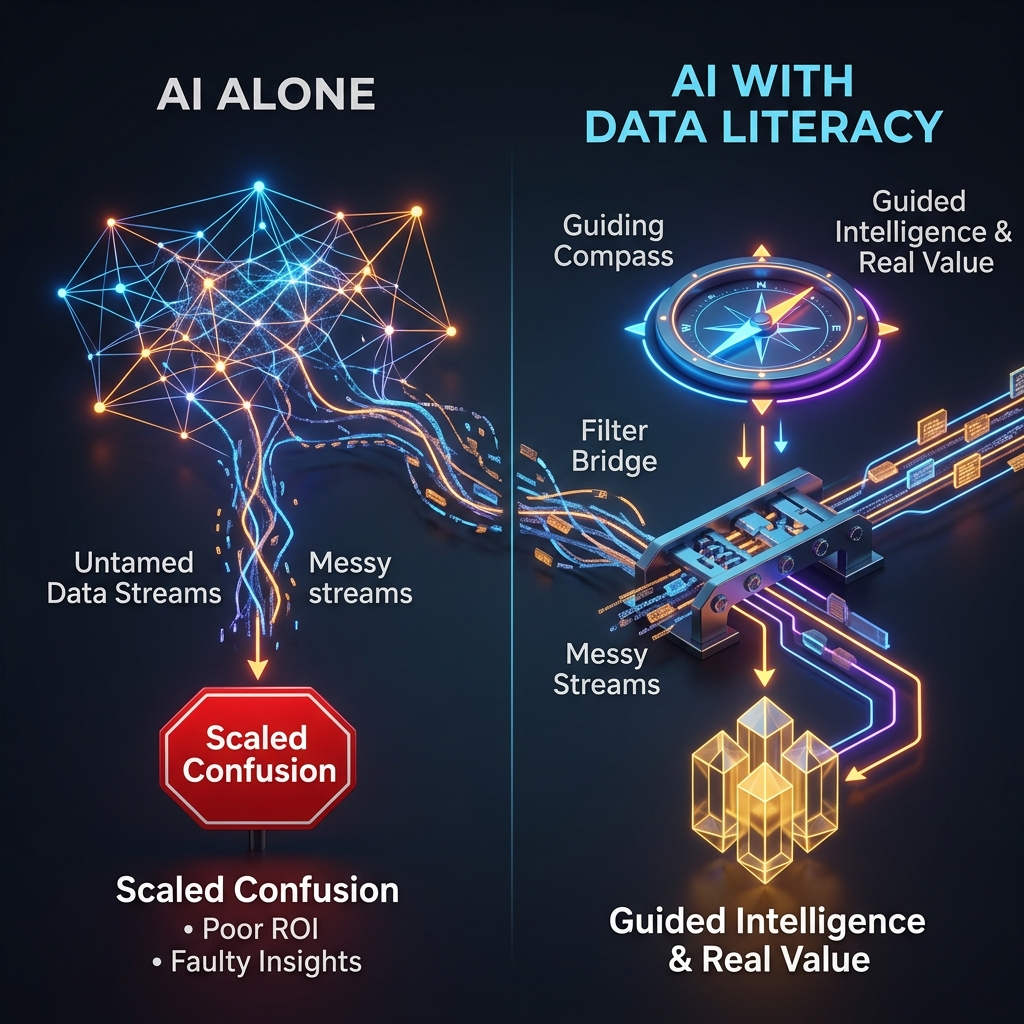
This image was generated using Antigravity.
“Culture eats strategy for breakfast.”
A quote that has survived decades of boardrooms, leadership offsites, and transformation decks. But in the AI era, it feels like there’s a modern sequel:
“Data literacy eats AI strategy for breakfast.”
Because no matter how advanced the model is, how many copilots get rolled out, or how often “agentic AI” appears in a PowerPoint, AI still cannot fix data that people fundamentally do not understand.
We’re living through the fastest AI adoption wave in corporate history. But while organisations race to implement copilots/claude, automation, and GenAI platforms, one uncomfortable truth is becoming increasingly hard to ignore:AI maturity is impossible without data literacy maturity. Some will agree. Some will disagree. But as AI adoption accelerates across industries, the gap between using AI and truly understanding the data behind it is becoming impossible to hide.
AI is the new corporate dress code - Hoodies in engineering. Blazers in consulting. “Agentic AI” in every second PowerPoint.
But between:
“Can ChatGPT do this?”
and
“Let’s roll out an AI strategy,”
many companies skipped a critical question:
Do We Actually Understand Our Data?
Because AI without data literacy is just speed without steering.
You might build faster.
You might automate harder.
You might even impress the board.
But if the data is messy, misunderstood, or untrusted, your “AI transformation” is just confidently scaled confusion.
The Great AI Rush
Right now, businesses across industries are sprinting toward AI adoption.
According to the 2025 Data & AI Literacy Report by DataCamp:
- 82% of leaders say their teams use AI at least weekly
- 88% believe basic data literacy is critical for day-to-day work
- Yet ~60% admit their organisation has an AI literacy skill gap
Which basically translates to:
“Yes, we’ve adopted AI.”
“No, we’ve quite figured out the operating model yet.”
And honestly, that’s not just a tech problem. That’s a business problem.
AI Is Not a Technology Strategy. It’s a Business and Technology Strategy.
Somewhere along the way, AI became trapped inside the “technology” bucket. But the companies seeing real success are not just the ones with the best models.
They are the ones with:
- clean data
- strong business context
- operational understanding
- and teams who can ask the right questions
Because AI does not magically understand your business.
It does not know:
- why a transaction was flagged
- why a trade looked suspicious
- why a trade was cancelled 30 seconds after execution
- why a risk limit breach is actually a data mapping issue, not a trader mistake
AI only sees patterns. Humans provide meaning.
Banking: The Perfect Example
Banks are currently one of the biggest adopters of AI.
And it makes sense:
- enormous data volumes across markets, risk, and operations
- high-frequency, repetitive workflows across functions
- heavily digitised trading and booking systems
- still-existing manual touchpoints in critical processes
- fraud detection and financial crime monitoring
- customer service and onboarding journeys
- market and credit risk analysis
- document-heavy workflows
- regulatory reporting and controls
It’s basically an AI buffet with every desk, function, and process trying to serve itself first..
A recent banking survey found:
- 54% of financial institutions have already deployed or are deploying GenAI
- 64% are using it to improve customer experience
- 58% for customer service
- 55% for internal productivity
But here’s where things get interesting. The AI use cases delivering real, measurable value in banking are mostly the ones where:
- data is standardised across systems and desks
- processes are well-defined and operationally mature
- business rules are explicit, documented, and consistently applied
Fraud detection works because transaction data has been normalised for decades. KYC automation works because document workflows are controlled. Trade surveillance and monitoring works because execution data is highly structured and lifecycle events are consistently captured and audited. Settlement and confirmations work because post-trade processes are tightly governed, with clear lifecycle states and reconciliation rules.
Meanwhile, the projects struggling are often the ones trying to “AI-transform” chaotic processes nobody fully understood in the first place.
Which leads to my favourite modern enterprise strategy:
“We don’t know how this process works…
so let’s add AI.”
Bold. Extremely bold.
Data Literacy: The Most Underrated Skill in the AI Era
We often think data literacy means:
- knowing SQL
- building dashboards
- understanding charts
- or saying “correlation is not causation” in meetings
But real data literacy is much broader.
It’s the ability to:
- question what the data is actually representing
- interpret business and operational context
- identify hidden bias in inputs and assumptions
- understand how real-world processes generate the data
- and recognise when numbers are technically correct but fundamentally misleading
Because data without business understanding creates dangerous confidence. And AI scales confidence beautifully, it doesn’t reduce that risk.
A model can produce:
- elegant reports
- polished summaries
- sophisticated predictions
- and completely wrong conclusions — all in under 8 seconds
Which is honestly impressive.
A global KPMG study found:
- 66% of employees do not evaluate AI outputs for accuracy
- 48% upload company data into public AI tools
- and 56% have made AI-related work mistakes
That’s not an AI failure. That’s a literacy failure.
The New Rockstar Employee
The future does not belong only to engineers, and it definitely does not belong only to prompt engineers who type:
“Act as a world-class senior strategic innovation consultant…”
The people who will thrive in AI-driven organisations are the ones who can combine:
| Skill | Why It Matters |
|---|---|
| Business Understanding | AI needs context |
| Data Literacy | AI needs quality inputs |
| Critical Thinking | AI outputs require validation |
| Communication | Insights are useless if nobody understands them |
| Technical Awareness | To know what AI can and cannot do |
The real competitive advantage is no longer:
“Can you use AI?”
It’s:
“Can you use AI responsibly, intelligently, and in a way that actually improves business outcomes?”
Huge difference.
AI Will Not Replace Domain Knowledge
This might be unpopular in some corners of LinkedIn, but:
AI is not replacing business expertise.
If anything, AI is increasing the value of people who deeply understand banking, risk, compliance, operations, trading, finance, and data ecosystems, because someone still has to judge whether outputs make sense, whether metrics are meaningful, and whether insights are actually real or just well-packaged noise.
AI can generate 500 lines of code but it can’t tell you if the KPI is flawed or the source system is broken and it definitely can’t decode business logic written in 2011 and left undocumented ever since.
The Real AI Maturity Curve
Most organisations think AI maturity looks like this:
- Buy AI tools
- Automate things
- Become innovative
- Win awards
Reality is more like:
- Discover terrible data quality
- Realise nobody understands the lineage
- Find 14 definitions of “active customer”
- Spend 9 months fixing pipelines
- Accidentally become data mature
- THEN successfully use AI
The irony? The companies winning with AI are often the companies that already invested heavily in:
- governance
- quality
- standardisation
- and business-aligned data culture
Not just GPUs and buzzwords.
Final Thought
AI is powerful. But AI without data literacy is amplification without direction, and in industries like banking where trust, regulation, accuracy, and decision-making matter, understanding the business is just as important as understanding the model.
The future is not AI vs humans. It’s:
humans who understand data and business,
working effectively with AI,
outperforming everyone else.
And maybe, just maybe, finally agreeing on a single definition of “customer” and stop discovering 14 different versions of it across 9 systems and 3 “golden sources.”